Guides · Updated November 2026
How to measure your waist correctly
A badly taken measurement can shift the result by a few centimetres. All you need is a soft tape measure, a mirror and a couple of minutes.
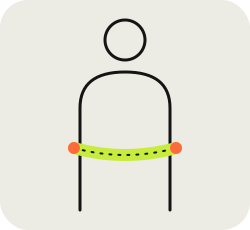
Waist
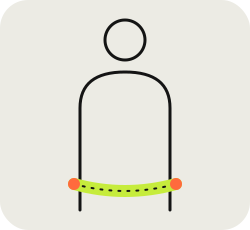
Hips
What you need
- A soft tape measure that does not stretch.
- A mirror, to check the tape is level.
- Light clothing, or bare skin around the area you are measuring.
Your waist, step by step
- Stand with your feet slightly apart and your arms by your sides.
- Use your fingers to find the bottom of your lowest rib and the top of your hip bone (the iliac crest).
- Wrap the tape around your body halfway between these two points.
- Check in the mirror that the tape is level and snug, without pressing into the skin.
- Breathe normally and read the measurement at the end of a breath out, without holding your breath or pulling your stomach in.
This is the method WHO uses in its population surveys. The belly button is not the reference point used by WHO.
Your hips
For the waist-to-hip ratio you also need your hip circumference. Stand with your feet together and wrap the tape around the widest part of your buttocks, keeping it level and not too tight.
Common mistakes
- Measuring over thick clothes or a belt.
- Pulling your stomach in or holding your breath.
- Letting the tape slope, higher at the back than at the front.
- Measuring at different times of day: after a meal your waist can be larger.
Comparing measurements over time
Always measure the same way: same time of day (for example in the morning before breakfast), same tape, same position. If a reading looks odd, measure twice and use the average.
Frequently asked questions
Should I measure my waist at the belly button?
That is not the reference WHO uses: it recommends the point halfway between the lowest rib and the top of the hip bone. Using the same point every time makes your measurements comparable.
Should I hold my breath?
No. Breathe normally and read the measurement at the end of a normal breath out, without pulling your stomach in.
How often should I measure?
There is no need to measure often: changes over a few days depend more on meals and posture than on real changes. Once a month, in the same conditions, is enough to see the trend.
Sources
- WHO – STEPS surveillance manual (physical measurements)
- WHO – Waist circumference and waist-hip ratio: report of a WHO expert consultation
This guide is for information only and summarises public WHO and NICE references. It is not a diagnosis and does not replace advice from a health professional.